FTSE Finish Line: June 10 — Whipsaw Tape as Miners and Banks Drag
FTSE Finish Line: June 10 — Whipsaw Tape as Miners and Banks Drag
London delivered a choppy Wednesday session, with the FTSE 100 briefly pushing higher at the open before slipping into the red as miners and banks came under pressure. The benchmark touched 10,259.28 in early dealing, then fell as much as 0.5% to 10,176.61 a little over half an hour before noon before clawing back from the lows to trade closer to flat. The tone was cautious rather than panicked. Renewed U.S.-Iran attacks and counterattacks kept Middle East risk firmly on the desk, but the market did not move in one straight line. Instead, investors faded early strength, cut exposure to China- and commodity-linked names, then selectively bought back defensives, property and consumer stocks as the morning progressed.
Miners were the main drag. Endeavour Mining fell 2.6%, Glencore lost 1.8%, Antofagasta dropped 1.6%, Fresnillo declined 1.4% and Anglo American slipped 1.3%. The move showed that geopolitical stress is not automatically bullish for the whole commodity complex. Oil and defence may catch a bid in escalation headlines, but metals are still exposed to growth nerves, dollar strength and weak risk appetite. Banks also weighed heavily. HSBC fell 2.5%, Standard Chartered dropped 2% and Lloyds lost 1%. The selling in HSBC and Standard Chartered kept the spotlight on Asia-exposed financials, which remain vulnerable after recent concerns around Chinese capital flows and tighter offshore banking conditions. Lloyds’ decline added a domestic angle, with investors still sensitive to the outlook for UK rates, credit demand and household resilience.
There was also meaningful weakness in data, analytics and growth-exposed names. Relx fell 3.6%, Experian dropped 2.6% and Polar Capital Technology Trust declined around 2.5%. LSEG, Airtel Africa, Sage, Pearson, St. James’s Place, Burberry, Diageo and AstraZeneca also traded in negative territory, showing the pressure was not confined to cyclicals alone. The sharpest stock-specific move came from WHSmith. The travel retailer fell as much as 14% after cutting its annual profit forecast for the second time this year, before recovering some of the initial loss. The downgrade hit confidence because WHSmith had been seen as a beneficiary of travel normalisation, and a second cut suggests margin pressure, execution risk or weaker-than-expected demand is proving harder to manage.
Still, the tape was not all red. Metlen Energy & Metals climbed more than 3%, continuing its recent strength. DCC gained 2.1%, while Land Securities, Associated British Foods, InterContinental Hotels, British Land, Games Workshop, Admiral, Tesco, Segro and Sainsbury rose between 1% and 1.7%. The gains in property, supermarkets and selected consumer names pointed to a defensive rotation rather than a broad risk rally. The property bid was notable. Land Securities, British Land and Segro all advanced, suggesting some investors are willing to add exposure where valuations already discount a difficult rate environment. Supermarkets also found support, with Tesco and Sainsbury moving higher as investors leaned into more resilient cash-flow stories. The bigger picture remains complex Middle East escalation keeps headline risk elevated, but the FTSE is being driven as much by sector rotation and stock-specific disappointments as by geopolitics. Banks and miners are acting as pressure points, while defensives and selected domestic names are cushioning the downside.
Finish Line: The FTSE 100 whipsawed from early gains to a 0.5% drop before recovering toward unchanged. Miners, banks, Relx, Experian and WHSmith did the damage, while property, supermarkets and selected consumer names helped stabilise the index. This was not a full risk-off washout, but it was a clear warning that investors remain quick to sell global cyclicals and earnings disappointments when Middle East headlines turn hostile.
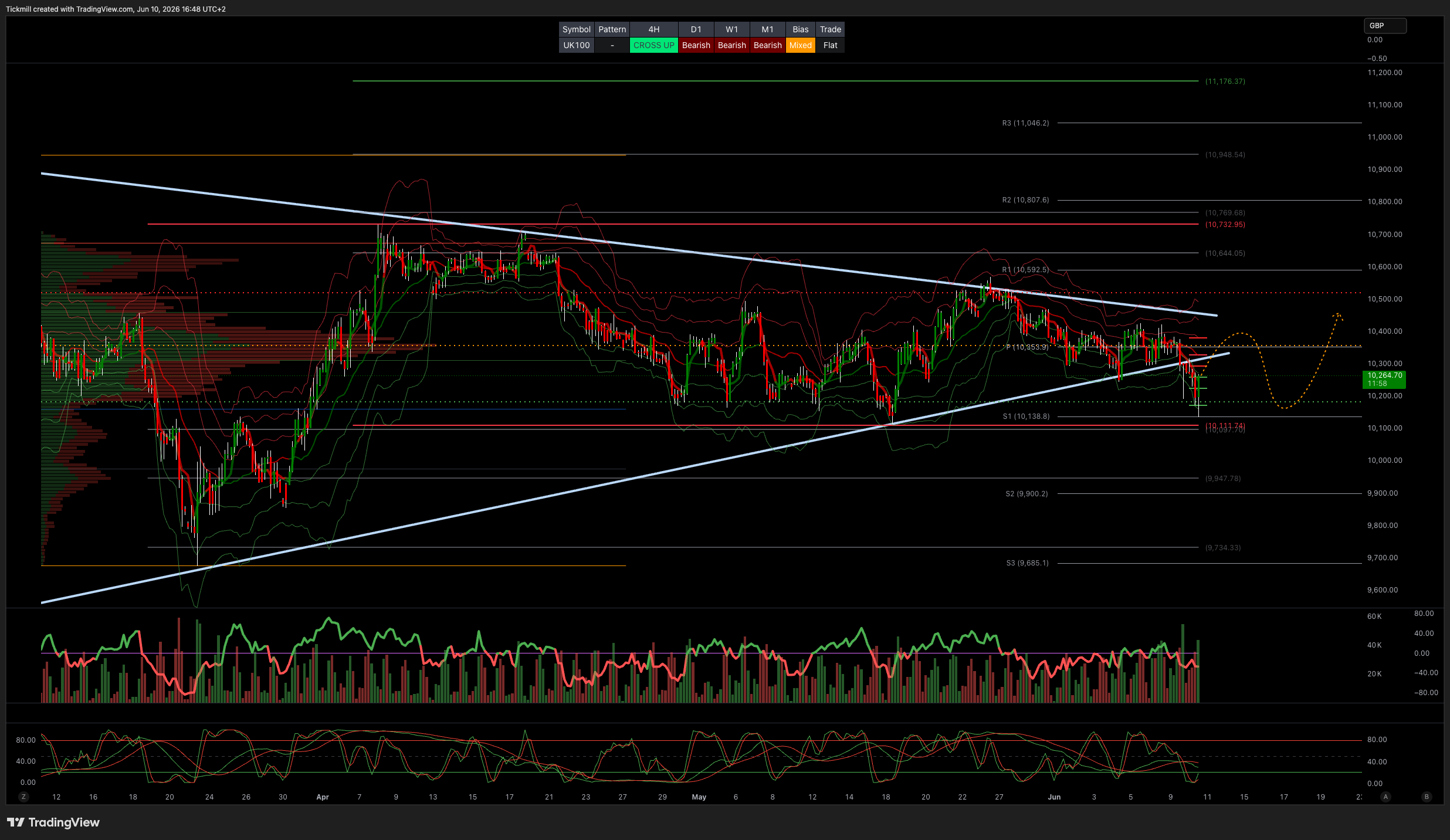
TECHNICAL & TRADE VIEW – FTSE100
Daily VWAP Bearish
Weekly VWAP Bearish
Above 10500 Target 11000
Below 10100 Target 9469
Disclaimer: The material provided is for information purposes only and should not be considered as investment advice. The views, information, or opinions expressed in the text belong solely to the author, and not to the author’s employer, organization, committee or other group or individual or company.
Past performance is not indicative of future results.
High Risk Warning: CFDs are complex instruments and come with a high risk of losing money rapidly due to leverage. 68% and 74% of retail investor accounts lose money when trading CFDs with Tickmill UK Ltd and Tickmill Europe Ltd respectively. You should consider whether you understand how CFDs work and whether you can afford to take the high risk of losing your money.
Futures and Options: Trading futures and options on margin carries a high degree of risk and may result in losses exceeding your initial investment. These products are not suitable for all investors. Ensure you fully understand the risks and take appropriate care to manage your risk.
Patrick has been involved in the financial markets for well over a decade as a self-educated professional trader and money manager. Flitting between the roles of market commentator, analyst and mentor, Patrick has improved the technical skills and psychological stance of literally hundreds of traders – coaching them to become savvy market operators!