Institutional FX Insights: CREDIT AGRICOLE FX WEEKLY - TAKING STOCK

CREDIT AGRICOLE FX WEEKLY - TAKING STOCK
The upbeat US Consumer Price Index (CPI) data for September sparked a renewed rally in the US dollar, pushing it to new yearly peaks. Initially, this led to a quick spike in USD rates and yields, but those gains were quickly reversed. It appeared that global markets were reaching their limits regarding tighter US financial conditions. The subsequent drop in US equities contributed to a significant shift in USD rates, indicating a potential ceiling that could be tough to breach without causing disruptions in other areas.
As US money markets seem to be pricing in an overly aggressive Federal Reserve stance, and with other central banks adopting hawkish tones, the influence of relative policy expectations on foreign exchange (FX) movements might diminish. This could limit the potential for further USD appreciation.
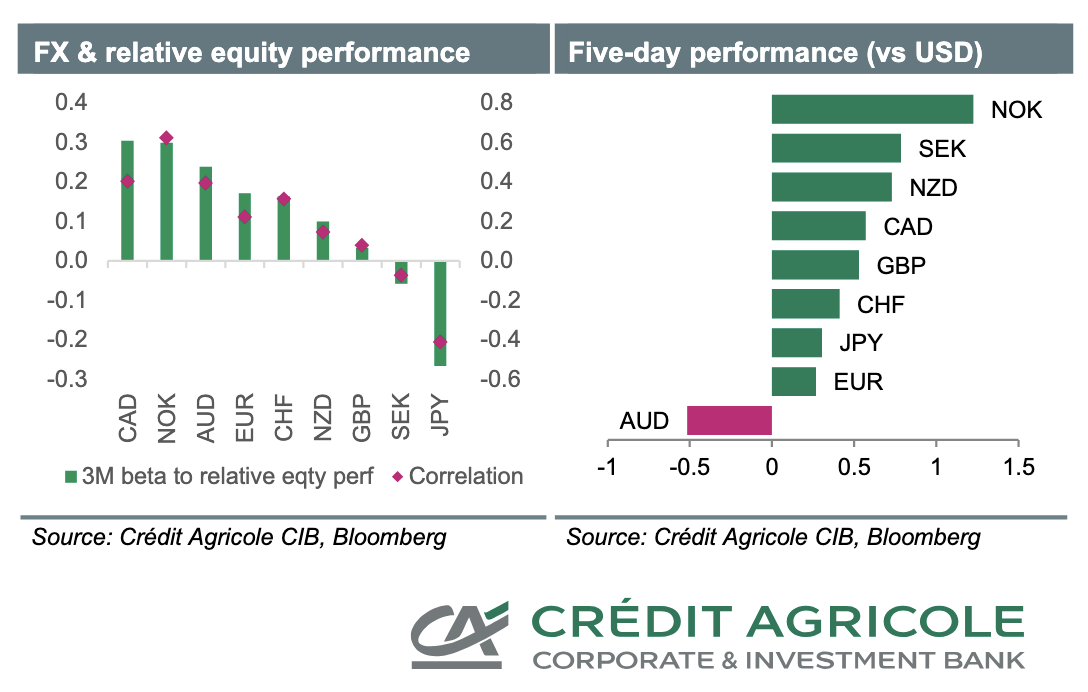
In this context, FX traders may start to explore alternative opportunities, particularly in equities. A notable trend over recent months has been the strong performance of US equities compared to most other developed markets. This divergence has played a crucial role in driving USD gains against many G10 currencies. Over the last three months, the USD/NOK and USD/CAD currency pairs have shown the highest betas and strongest correlations with relative equity performances. Consequently, in a favorable environment where US equities struggle to set new records while other markets gradually catch up, both the Norwegian krone (NOK) and Canadian dollar (CAD) could be well-positioned to regain some ground—especially if energy prices remain high due to rising tensions in the Middle East.
However, any retracement should steer clear of evolving into a broader correction across global markets, particularly with increasing concerns surrounding artificial intelligence worldwide. The upcoming US earnings season is expected to gain momentum next week, although it may lack significant tech sector indicators. Instead, investors will likely pay close attention to the latest Treasury International Capital (TIC) data to evaluate foreign investment participation in the US equity rebound observed in August, even though the USD's performance during that month was rather mixed.
While foreign exchange hedging strategies remain uncertain following the reality check of Q2 2025, the growing interest in risk-correlated US assets could potentially diminish the safe-haven allure of the USD during turbulent times.
On another front, upcoming CPI data from Canada and the UK could play a pivotal role in determining whether the Bank of Canada (BoC) and the Bank of England (BoE) will initiate rate hikes in the coming weeks. For the eurozone, a smooth progression through the French budget process could provide significant relief, especially considering the resilience of leading indicators within the region.
Disclaimer: The material provided is for information purposes only and should not be considered as investment advice. The views, information, or opinions expressed in the text belong solely to the author, and not to the author’s employer, organization, committee or other group or individual or company.
Past performance is not indicative of future results.
High Risk Warning: CFDs are complex instruments and come with a high risk of losing money rapidly due to leverage. 68% and 74% of retail investor accounts lose money when trading CFDs with Tickmill UK Ltd and Tickmill Europe Ltd respectively. You should consider whether you understand how CFDs work and whether you can afford to take the high risk of losing your money.
Futures and Options: Trading futures and options on margin carries a high degree of risk and may result in losses exceeding your initial investment. These products are not suitable for all investors. Ensure you fully understand the risks and take appropriate care to manage your risk.
Patrick has been involved in the financial markets for well over a decade as a self-educated professional trader and money manager. Flitting between the roles of market commentator, analyst and mentor, Patrick has improved the technical skills and psychological stance of literally hundreds of traders – coaching them to become savvy market operators!